
Rooflight Daylight Design Principles
Definition of Daylight
The CIE (Commission Internationale de L’Eclairage) Overcast Sky is the standard used throughout northern Europe for calculating daylight.
- Daylight is classified as the natural light from an overcast sky.
- Sunlight is the natural light from a direct sunbeam, not obscured by clouds.
The standard CIE Overcast Sky is considered to be:
- Three times brighter overhead than it is on the horizon.
- Of the same brightness in all compass directions.
Convention assumes that if a building is designed for daylighting according to the CIE Overcast Sky conditions then, when outdoor illuminance is brighter, the natural lighting performance will be significantly better.
It is assumed that the minimum yearly average outdoor illumination is 5,000 lux for 85% of a normal working day. This represents a dull day. By the same standard a sunny day is assumed to be 100,000 lux. This is the maximum design illuminance.
Distributions of Sky Luminance
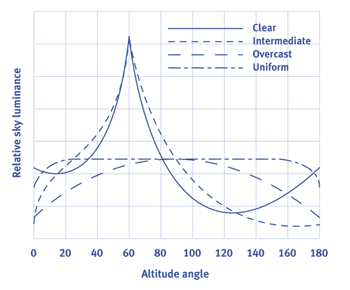
The sky distributions graphs were generated with the RADIANCE synthetic imaging system. The sun was assumed to be at an altitude of 60° due South. The sky luminance was then mapped between the Southern (0°) and the Northern (180°) horizon passing through the zenith (90°). Please note that graphs should not be compared to one another, i.e. it is not correct to say that uniform and overcast skies always have the same zenith brightness.
Clear SkyThe luminance of the standard CIE clear sky varies over both, altitude and azimuth. It is brightest around the sun and dimmest opposite it. The brightness of the horizon lies in between those two extremes. |
 |
Intermediate SkyThe standard CIE intermediate sky is a somewhat hazy variant of the clear sky. The sun is not as bright as with the clear sky and the brightness changes are not as drastic. |
 |
Overcast SkyThe luminance of the standard CIE overcast sky changes with altitude. It is three times as bright in the zenith as it is near the horizon. The overcast sky is used when measuring daylight factors. It can be modelled under an artificial sky. |
 |
Uniform SkyThe luminance of the standard CIE overcast sky changes with altitude. It is three times as bright in the zenith as it is near the horizon. The overcast sky is used when measuring daylight factors. It can be modelled under an artificial sky. |
 |