
Illumination Levels
The onus is on the building designer to select the light level most appropriate to the intended use of the building. Recommended illuminances for specific activities are contained within the CIBSE Guide for interior lighting 1994.
A standard overcast sky is generally represented as 5,000 Lux. However, this is not constant for all times of the day or parts of the year.
Daylight Factor % |
Standard maintained illuminance (Lux) |
Interior/activity |
Examples |
| 2 - 3 | 50 - 100 | Interiors used occasionally, with visual tasks confined to movement, limited perception of detail. | Corridors, bulk stores. |
| 3 - 4 | 150 - 200 | Continuously occupied interiors, visual tasks not requiring perception or detail. | Loading bays, plant rooms. |
| 6 - 10 | 300 - 500 | Moderately difficult visual tasks, colour judgement may be required. | Packing, general offices, engine assembly, retail shops. |
| 12 - 20 | 750 - 1000 | Difficult visual tasks, accurate colour judgement required. |
Drawing offices, chain stores, general inspection, electronic assembly, supermarkets. |
| 30 - 40 | 1500 - 2000 | Extremely difficult visual tasks. | Precision assembly, fabric inspection. |
Horizontal or Vertical Measurements?
For greatest relevance, light levels can be measured vertically or horizontally depending on the use of the building.
- In office and manufacturing environments it is usually best to measure light levels horizontally because the tasks being undertaken tend to happen in a regular horizontal plane.
- In warehouses or storage areas where racking is used, it is better to analyse light levels vertically.
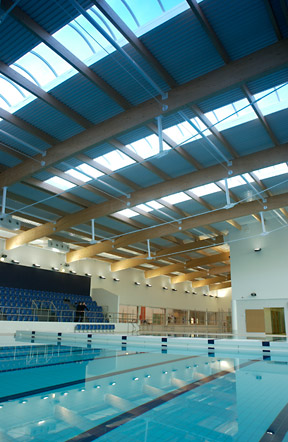
Barrel Vault specialist glazing