Xtralite Daylight Consulting Service
To achieve the desired lighting level Xtralite can assist architects and specifiers with the Xtralite daylight consulting service.
Using the formula described in ‘Predicting Daylight’ calculating the daylight factor for a single point in a room cannot always be relied on to ensure that rooflights and windows are positioned to greatest effect within a room. Xtralite has recognised this and hence offers customers a free consulting service in which an advanced computer modelling system is used to predict the best rooflight sizes and location. The designer can then confidently build rooflights into the architectural proposition to ensure their ideal positioning.
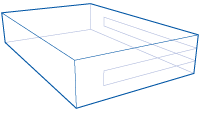
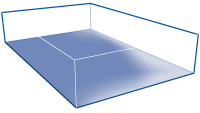
For example, diagram 1A illustrates a standard sized room featuring windows along two sides. When this is analysed within the Xtralite modelling system it can be seen in diagram 1B that the daylight factor is exceptionally high close to the widows and low in the rest of the room.
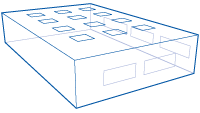
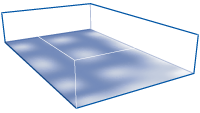
Diagram 2A shows the same sized room but with a series of smaller windows along two sides and an even distribution of rooflights in the roof. Using the Xtralite modelling system it can be seen in diagram 2B that daylight is distributed much more evenly.
Comparing the two layouts, the window and rooflight configuration in 2A/2B has a smaller glazed area than 1A/1B and yet produces a higher average daylight factor, therefore representing better daylighting throughout the room.
To take advantage of the Xtralite consulting service email sales@xtralite.co.uk.
Calculating Light Transmission of a Rooflight
The light transmission (LT) qualities of rooflights vary according to the design and the materials used. For instance, polycarbonate systems range from 79% for a double skin clear product and 77% for a double skin diffusing product to around 45% for similar products in bronze or opal.
If, working to the same formula as the diagram, the rooflight has a triple skin with the intermediate being a clear polycarbonate and the inner a diffuser, the overall light transmitted into the building would be 69%.
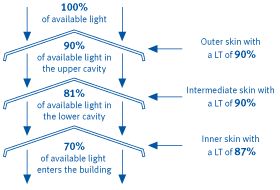
Alternatively, if the outer skin has a light transmission of 70% and the inner skin 75%, then the overall light transmission would reduce to 52%, thereby effectively losing over 30% of the light into the building.
Types of Daylight
The materials specified in rooflights can play a major role in determining the type of light, either direct or diffused, and amount of light entering a building. If direct light and diffused light materials have the same light transmission rating they will let equal amounts of light into a building, the light is simply distributed in a different way.
Direct Light
Direct light passes through rooflight glazing without any disruption or interference and enters the building as a straight beam. Polycarbonate and clear glass materials may provide direct light. Direct light:
- Gives strong light in the area of the beam but less general light in the surrounding areas.
- Produces shadows and glare on sunny days.
- Is ideal for environments where the designer wants to create a natural environment and allow the sky to be viewed.
- Gives uninterrupted external vision.
Diffused Light
Diffused light is when the light passing through rooflight glazing is diffused (scattered) by the materials used for the rooflight. Polycarbonate and some patterned and opal tinted glass materials diffuse light. Diffused light:
- More evenly distributes light into the building.
- Is useful for creating ambient light over a larger area with minimal shadows.
- Commonly used for industrial, commercial and sporting facilities.
- Provides privacy.
| 1A & 1B | |
|
|
Room dimensions: |
20 m x 15 m x 3 m |
Windows: |
18 m x 1.2 m and 13 m x 1.2 m |
Total glazed area: |
37.2 m² |
Minimum daylight factor: |
0.6% |
Average daylight factor: |
3.5% |
Maximum daylight factor: |
25.8% |
| 2A & 2B | |
|
|
Room dimensions: |
20 m x 15 m x 3 m |
Windows: |
5 windows, each being 2 m x 1.2 m |
Total window area: |
12 m² |
Rooflights: |
12 rooflights, each being 1.2 m x 1.2 m |
Total rooflight area: |
17.28 m² |
Total glazed area: |
29.28 m² |
Minimum daylight factor: |
1.1% |
Average daylight factor: |
4.3% |
Maximum daylight factor: |
26.2% |