Maximising Energy Efficiency with Rooflights
Taken at face value, the Building Regulations Part L Approved Documents (and other similar national regulatory guidelines) seem to approach rooflights purely from the perspective of limitation due to a lower insulation value than typical roof constructions. This approach ignores rooflights as an effective light source in their own right, with substantial potential for reduction in energy used by artificial lighting. A more holistic approach is needed, as exemplified by recent research carried out by De Montfort University.
The research brings together thermal effects with energy used for heating and illumination effects with energy used for artificial lighting—applied to a range of buildings. The findings proved conclusively that rooflights provide an overall energy benefit—with the level of that benefit depending on various factors, in particular:
- The total area of rooflights
- Design illumination level
- Type of artificial lighting control used
- The pattern of building use.
Increasing the rooflight area reduces the need for artificial light, cuts the energy requirement of the building and reduces CO2 emissions. It is therefore a straightforward means of meeting a building’s target emission levels under the current Building Regulations and reducing its carbon footprint.
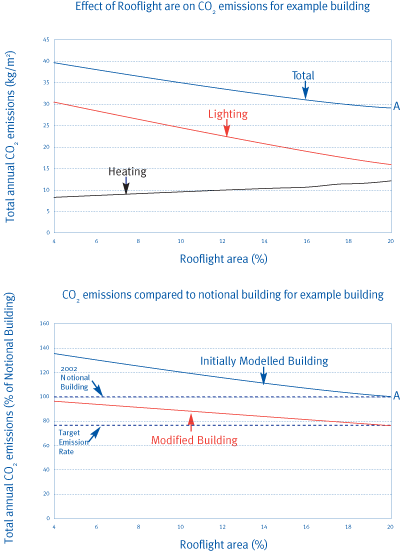
By considering insulation values alone, it might be expected that heating requirements would grow as rooflight area increased. However, the research proves that for a building occupied primarily during the day this is not the case, as passive solar gain through the rooflights actually balances the insulation value. Therefore, heating requirements are barely affected and the most dominant effect by far is the decreasing requirement for artificial light as rooflight area is increased, as illustrated in the graph.
In the case of a building occupied between 9am—5pm every day of the year, with a lighting requirement of 300 lux, some 23 kg CO2/m²—a massive 85%—saving in emissions will result from using 20% rooflights. For a building occupied 24 hours a day—the worst case scenario for rooflights, with no night-time benefits from natural light or passive solar gain— they still provide a very significant energy benefit. In almost all cases, a rooflight area of 15%—20% will achieve almost all the available savings in overall energy use and CO2 emissions. To maximize these benefits, designers need to carefully consider interaction with artificial lighting, which will be essential during parts of the working day—particularly in the winter months—and specifically in working areas where light levels need to remain constant. Automatic controls will be needed to minimise the use of artificial lighting, so maximising energy savings from daylight.